Posts

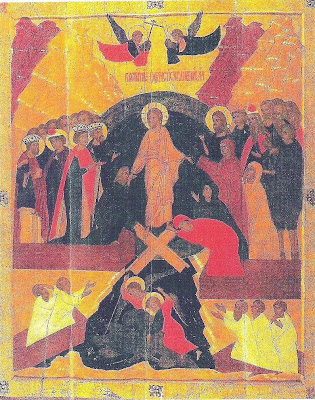
Icon of the Resurrection
Image
Icon of the Resurrection Pskov, Later Sixteenth century In the wording of the Creeds, Jesus was “crucified, died, and was buried. On the third day, he rose again...” This icon illustrates some of the early traditions about what the Spirit of Jesus was doing in that interval, while his body laid in the tomb. Also called: “The Harrowing of Hell,” this icon of the Resurrection is part of the collection of the Andrei Rublev Museum in Moscow, dedicated to preserving early Russian art, and named after one of history’s greatest iconographers. It is located in a former monastery, where Saint Andrei Rublev once lived and worked. The area around Pskov and Novgorod was known for a relatively egalitarian social system, in terms of gender relations. This is reflected in the center of the icon, where Jesus has the hands of both Adam and Eve, pictured as regular human beings, minus the haloes of saints. He pulls them up from Hades, along with many figures from the Hebrew Bible, who had died bef...

Epitaphios

Image
Epitaphios – the Entombment of Christ This Greek Orthodox icon was written by iconographer, Anathios Clark, in a stark and simple form that conveys the grief and devastation of the little group that laid Jesus in the tomb that Friday at dusk. Though there are sometimes others in the scene, the people most often depicted in the Epitaphios (related to the Greek word: epitaph) who took Jesus down from the Cross and placed him in the Tomb are Mary, his Mother; Mary Magdalene; John the “Beloved Disciple,” and Joseph of Arimathea, as mentioned in John, Chapter 19. Dressed in the dark terra-cotta color of the red earth, Mary bends low over Jesus and is shown here in a touching gesture that movingly duplicates the cheek-to-cheek caress of Mother and Child in the icons known as “Valdimirskaya” and “the icon of humbleness.” Behind her is Mary Magdalene, who is crying out in her grief and distress, hands raised in the “orens” position of outspoken prayer. In her role as preacher and pr...

Icon of the Crucifixion

Image
Icon of the Crucifixion Russia, Late Sixteenth century Depicting the moment when Jesus bequeaths Mary and John to each other: “Woman, Behold your son,” the simple composition of this icon reflects the gravity of this world-changing event. Above the Cross, two grieving angels, representing the sun and moon often seen in Crucifixion scenes, attend Jesus. Though John, said to be the “beloved disciple” is often dressed in brilliant red, in this icon he wears muddy, earthy green and terra cotta colors. Mary’s outer red robe has so much dark pigment in it that it appears nearly black. Standing behind to support her is Mary Magdalene, who stayed with Jesus to the very end, as it says in the Gospel of John. She wears the brighter red robes of a witness, one who testifies. Standing behind John is the centurion, whose name has come down in tradition as Longinus, though he is not named in the Gospels. He is the Roman soldier who saw Jesus at the moment of his death and proclaimed: “In tru...

Jesus Washing the Feet of the Disciples

Image
John 13:1-38 Pskov, Early 16th century This icon is a panel in an iconostasis (icon screen) now in the collection of the Pskov Museum. An ancient city of Northern Russia, icons from Pskov and Novgorod have many attributes in common, including great theological depth of meaning. The iconostasis from which this icon comes stood in the Thirteenth-century Church of the Archangels Michael and Gabriel in Gorodets, Pskov District, until 1927, when it was confiscated by the new Soviet regime. During WWII, it was looted by the Nazi invaders of the region, but was returned to the people of Pskov after the War. The faces of the characters in the icon are typical portraits of people from the Pskov region in the Middle Ages, with dark skin and hair coloring. One of ten panels located in the Church Feast Tier of the large iconostasis, this icon includes many interesting features. Note the cock sitting on a column, waiting for his cue to crow, at the top of the composition. It is a deta...

Prayer on Holy Saturday

Image
God of Glory, yesterday we all ran away, or at least tried to keep a safe distance from your suffering and death. This day, like so many others, we are lost, and know not what you are doing behind the scenes. Your tomb seems rock solid, just like the oppressive empires and the despair which haunt us. Yet your life is now beyond death, hidden from our view and shrouded in Holy Mystery, like yeast in a large measure of flour. Help us rise on your new day, and lift the veil from us, that we may see your living Word and be made new with resurrection Glory, in the name of Jesus Christ, who awaits our awakening. Amen. Artwork: Tomb, by Sieger Köder.

Lessons for the rest of Lent

Image
For the remaining three Sundays of Lent, here are links to earlier posts, which have been visually updated since they were first posted. Lent 4A Ephesians 5:8-14; John 9:1-41 - Things Done In the Dark Of course, “darkness” is used as a metaphor. Nowadays we don’t often spend much time in the real dark. If we’re out at night there are streetlights or headlights to illumine the way. At home there’s the comfort of light bulbs and the glow of TVs. Even adventurous cave explorers take light with them. Yet darkness is unfortunately not that strange to us. At times it can be dark indeed.... Lent5A Ezekiel 37:1-14; John 11:1-45 - I Felt the Lord's Power A modern Ezekiel might be taken to a small town on the prairie, where the local business are dried up and the next generation is exiled to another land. He or she might walk down the streets in certain neighborhoods, looking at foreclosure properties. The prophet might be transported by bus to the furthest corners of our states, whe...

He Told Me Everything I Have Ever Done!

Image
Third Sunday in Lent March 27, 2011 John 4:5-42 She came to the well every day at noon, when the sun was hottest. The other women in the village had long since gone back to their households, lugging the heavy water that sustained life and health in a dry land – as millions of women still do, daily, in poor and developing nations all over the world. Coming to the well at midday meant that she could avoid the dulling pain of being shunned and frozen out of the cheerful group that would meet each morning at the well, to carry the water in the cool of the day. Some traditional depictions of this story portray this Samaritan woman, someone who was very much an “other” to the Jews, as a sort of Bible-story version of Zsa Zsa Gabor or Elizabeth Taylor – a “use ‘em and lose ‘em” character with all her many husbands, a “woman of the world.” But more recent – and careful – scholarship, that takes the anthropology and social structures of that time and place into account, gives us a differe...